Warehouse & industrial property rental in Greece
✦ Key Takeaways
- The industrial and logistics market remains tight. Rents for modern warehouses run at €5.75–6.4/sqm/month, with yields around 6.75–7% for quality assets.
- Many modern facilities are pre-let before construction is even finished — searches need to start early, and often outside public listings.
- A significant part of the market operates off-market: owners deal directly with specialist advisors or specific prospective tenants, and the opportunity never reaches a public listing.
- Confirming permitting and land-use eligibility has to come before you shortlist a property, not after.
- The real cost of a lease goes beyond the monthly rent: deposit, stamp duty or VAT, municipal fees, insurance and fit-out works all add to the bill.
- The legal minimum term for new commercial leases is three years, but everything else — rent review, works, exit terms — is freely negotiated. That's where the deal actually gets made or lost.
- Whether to lease, buy or go build-to-suit depends on your time horizon and how specific your fit-out requirements are.
📌 The prices and market data below refer mainly to modern big-box logistics warehouses. Smaller or older facilities can see materially different rent levels and availability.
This guide is intended for companies looking to lease warehouse, logistics or industrial space in Greece — manufacturers, distributors, 3PL providers, importers and e-commerce businesses.
Greece's logistics and industrial property market entered 2026 with clear momentum. Rents for modern Grade A warehouses sit at €5.75–6.4/sqm/month, and yields on top-tier assets are running around 6.75–7%. Availability of modern prime space remains extremely tight.
The defining feature of this market is a timing mismatch between supply and demand. Roughly 800,000 sqm of new warehouse space is expected over the next three years, backed by more than €800 million in investment — but that pipeline can't meet today's immediate demand, because it's under construction, not ready to occupy. Plenty of companies are looking for a warehouse they can move into now, and there simply aren't many of those: much of the space under construction is either being built by its future occupier for their own use, or has already been pre-let well before completion.
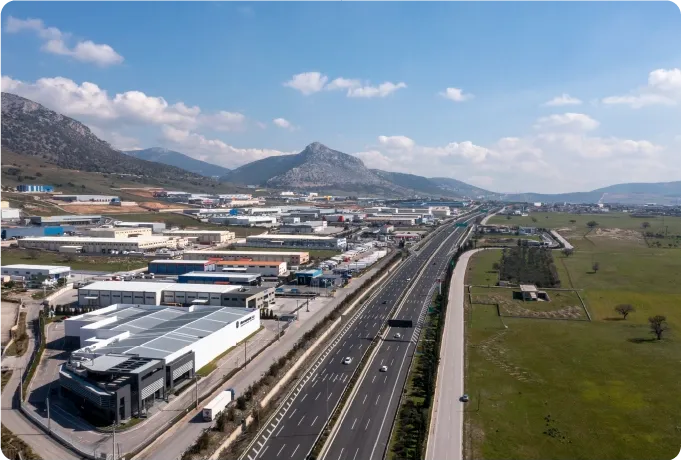
West Attica — Aspropyrgos, Elefsina and Mandra — anchors this market largely because of its position: close to Athens, on the national road network, and within easy reach of Piraeus, Greece's main container port. That proximity is a big part of why the area has absorbed most of the country's new logistics investment, and why most Grade A space gets pre-let before it's even finished: occupiers who depend on port access don't want to risk missing out on the few modern facilities available there.
In practice, that means two things if you're looking for space:
- Start early, and be open to space that's still under construction, with delivery on a reasonable future timeline. Waiting for something move-in ready usually means the best options are already gone.
- Get access to off-market opportunities. A meaningful share of Grade A supply changes hands without ever appearing on a public listing — owners go straight to a trusted advisor or a specific short list of occupiers they already know can move fast. If your search only covers what's publicly listed, you're missing a real part of the market.
💡 In the logistics market, speed of decision-making is often a genuine competitive edge. The best space can get taken within days.
This is exactly where a specialist industrial property advisor earns their keep: they know what's about to come free before it's ever listed, and can cut your search time down significantly.
(See in depth: How to choose a logistics location in Attica.)
Get it right from the start: what to check before you view your first property
The most common mistake in an industrial or warehouse search is starting from the listings, instead of from what's actually permitted.
Before you start looking, you need to keep in mind:
- What the permitting requirements are, and which land uses allow your activity. Not every industrial or warehouse use is allowed everywhere.
- Every area has its own quirks — land use, drainage, power availability and other infrastructure vary from one location to the next.
- Every property has its own characteristics. A building can sit in the right zone and still lack what your specific use requires.
Land-use rules and permitting requirements change fairly often, so something that was true two years ago may no longer hold today. That's why working with an engineer who knows the specific area and the current regulatory framework isn't a luxury — it's what stops you negotiating a property that ultimately can't support what you actually do there.
A business that skips this preliminary check risks spending weeks on viewings and negotiations, only to find out the activity can't be licensed at that particular property. This check is usually carried out by an engineer with experience in industrial and warehouse permitting.
Sequencing matters here: confirm the property can legally support your activity first, then start the real search.
Choosing the right type of property
A 3PL operator's requirements look very different from a manufacturing plant's. The main categories you'll come across:
| Space type | Best suited for |
|---|---|
| Dry cargo warehouse | General storage and distribution |
| Cold storage | Temperature-controlled goods |
| Industrial space | Manufacturing activity |
| Cross-dock | Fast-moving freight, no extended storage |
| Logistics centre | Large-scale 3PL / distribution |
Whatever the category, there are technical specs worth checking every time:
- Clear height — modern warehouses are designed with an internal clear height above 12.5m, which is hard to find in older stock.
- Floor load capacity — critical for heavy racking or industrial equipment.
- Floor flatness — determines how safely and efficiently forklifts and other handling equipment can operate, especially in automated warehouses.
- Number and type of loading docks.
- Fire protection, depending on the category of goods stored.
- Power supply, especially important for industrial use or cold storage.
(See in depth: Modern warehouse specifications — what "Grade A" actually means.)
Choosing the right location
Location isn't just about price — it drives transport costs, delivery times, access to ports and road networks, labour availability, and the area's future growth prospects.
| Area | Best suited for | Indicative rent range (€/sqm/month) |
|---|---|---|
| Aspropyrgos | Warehouses, logistics, distribution, industrial | 5.5–6.4 |
| Elefsina | Warehouses, industrial | 5.5–6.5 |
| Mandra, Magoula | Warehouses, industrial | 5–6 |
| Mesogeia | Airport logistics | ~4.7 |
| Oinofyta | Warehouses, industrial | 3.5–4.5 |
| Sindos (Thessaloniki) | Northern Greece, export activity | case by case |
In the market, "Thriasio Pedio" typically refers collectively to Aspropyrgos, Mandra, Magoula and Elefsina — the areas currently seeing the most investment activity and the bulk of new development in Attica. By contrast, in areas like Oinofyta and Thessaloniki, most of the existing building stock is older, which affects both the availability of modern specifications and rent levels.
(See in depth: How to choose a logistics location in Attica.)
The real cost of a lease
The monthly rent is only part of the total cost. Before committing, make sure you have a clear picture of:
- Rent — based on floor area and location.
- Deposit — typically 2–4 months' rent, negotiable.
- Stamp duty or VAT — commercial leases attract either 3.6% stamp duty or VAT, depending on what's agreed between landlord and tenant.
- Municipal fees — a critical, often underestimated cost.
- Insurance for the space and its contents.
- Maintenance — who's responsible for what (see "What to agree before you sign" below).
- Fit-out works, where needed (racking, M&E work, office build-outs).
The point of this section is simple: the true cost of a lease is always higher than the headline rent, and a realistic budget accounts for that from the start.
As a rule of thumb, here's who typically pays what:
| Cost | Usually paid by |
|---|---|
| Rent | Tenant |
| Stamp duty or VAT | Tenant |
| Municipal property tax (ENFIA) | Landlord |
| Municipal fees | Tenant |
| Insurance | Per contract |
This split reflects standard market practice, but it's always finalised in the lease itself — don't assume it without an explicit agreement.
💡 The warehouse with the lowest rent often isn't the cheapest option overall. A space with better specifications can meaningfully cut operating costs, handling time, and future fit-out spend.
What to agree before you sign
Before the lease is drafted, there are commercial points that need to be settled between the parties. This isn't legal analysis — it's the practical detail that causes problems later if left vague:
- Lease term — the legal minimum for new commercial leases is three years, but the parties are free to agree a longer term, which then binds both sides.
- Deposit — amount and return terms.
- Rent review — which index it's linked to, and how often it's reviewed.
- Works to be carried out — who does them, and who pays for them.
- Delivery timeline for the space.
- Maintenance — division of responsibilities between landlord and tenant.
- Early exit — under what conditions, and at what cost.
- Use restrictions, if any apply to the activity.
- Rent commencement date, particularly if fit-out works come first.
- Right to expand or lease adjoining space, if that's on the table.
The clearer these points are before signing, the fewer disputes come up over the life of the lease.
For more detail on term, rent review, deposit, maintenance and lease termination, read our full guide to commercial leases in Greece.
From search to move-in: the process step by step
- Define requirements — floor area, space type, location, budget.
- Check activity compatibility — confirm which zones and land uses permit your activity, before briefing an agent.
- Market search — public listings and off-market contacts.
- Shortlist — 3–5 candidate properties for evaluation.
- Viewings — site visits, assessing specifications.
- Heads of Terms — initial negotiation of commercial terms.
- Technical due diligence — checking permits, land use, structural condition, fire safety, and any outstanding compliance issues.
- Final agreement — incorporating any findings from due diligence that affect the initial terms.
- Sign the lease.
- Delivery and fit-out.
Timeline: Depending on market availability and your requirements, the process from defining your needs to moving in can take anywhere from a few weeks to several months. For large facilities or build-to-suit projects, expect it to take considerably longer.
(See in depth: Technical due diligence before leasing · How to negotiate a commercial lease.)
Lease, buy, or build-to-suit?
| Option | When it makes sense |
|---|---|
| Lease | You need flexibility, don't want to tie up capital, or your need has a medium-term horizon. |
| Buy | Your use case is long-term and you have capital available or access to financing. |
| Build-to-suit | Your requirements are specific (height, floor loads, cold storage) and existing stock doesn't cover them. |
The more specific a company's requirements are, the more likely a build-to-suit project is to work out cheaper and more efficient than adapting an existing property.
Own an industrial property? Demand remains strong today, but the wave of new investment coming over the next few years carries a real risk that the balance of the market could tip in favour of the demand side. For older, second-tier stock, the outlook is even less certain. If you're weighing up a sale or a lease, timing matters.
💡 The sooner you lock in a long-term lease, the better — and the more modern a property's specifications, the faster and more easily it lets.
(See in depth: Build-to-suit vs. an existing warehouse · Sale & leaseback for industrial property · How to sell or lease your industrial facility.)
Conclusion
In a market where modern space is limited and technical, permitting and commercial factors all shape the outcome, getting a lease right isn't just about the rent. It's about choosing the right space, in the right location, on the right terms, with no unpleasant surprises after you've signed.